


Answer Engine Optimisation: The Complete B2B AEO Guide
By Daniel Elliott-May, SEO Executive · Updated August 2026
Buyers used to search for links. Now they ask for answers. Open ChatGPT, Perplexity or Google's AI Mode, ask which vendors are worth considering, and you get a recommendation rather than a results page. That recommendation is assembled from sources most brands have never audited.
Answer engine optimisation is the work that puts your brand inside those recommendations. This guide covers what answer engines reward, what a B2B AI answer is built from, and the tactics that earn your brand a place in one. It draws on our analysis of 1,052,053 AI citations across six B2B SaaS brands, so the guidance maps to observed patterns rather than guesswork.
Key Takeaways
- Answer engine optimisation (AEO) is the practice of structuring content and building authority so AI systems can extract, trust and cite your brand as a direct answer.
- Most of an AI answer is not your website. In our study, competitor and peer sites accounted for around 38% of citations, community platforms 19%, trade press 9% and review platforms 4%.
- Two measures matter, and they differ. A brand mention is being named in the answer; a brand source citation is your own site being used as a source. Across the six brands studied, source citation ranged from 9% to 32% of the answers that mentioned them.
- Owned content earns eligibility; off-site presence earns breadth. Without a strong, extractable page there's nothing to cite. Without third-party presence you're absent from most of the answer.
- The work is a map, not a list. Each off-site tactic targets a specific slice of the citation pool, which tells you where to spend.
What Is Answer Engine Optimisation?
Answer engine optimisation is the process of structuring content and building authority so AI systems — ChatGPT, Google AI Overviews, Google AI Mode, Perplexity and Gemini — can extract, trust and cite your brand as a direct answer. Traditional SEO competes for rankings. AEO competes for citations inside the answer itself.
For B2B companies, where buying decisions take months and trust is built long before a sales conversation, that distinction carries weight. The brand cited as the answer to "what's the best [your category] solution?" isn't winning a click. It's winning a place in the consideration set, before anyone visits a website.
What Is an Answer Engine?
An answer engine generates a direct response rather than a list of links. It retrieves sources, synthesises them and cites some. The retrieval step is what matters commercially: the model chooses which sources to build from, and that choice happens before your website gets a look in.
Google's AI Mode works differently. Rather than retrieving sources at query time in the way ChatGPT or Perplexity do, it's deeply integrated with Google's index, so your organic authority feeds directly into whether you surface. That's why strong technical SEO foundations still underpin everything here.
Why Does AEO Matter in B2B Marketing?
Because B2B buying is research-led, and research is where AI answers have taken hold. Specialist questions, provider comparisons, evaluation criteria, long buying journeys with multiple stakeholders: these query types most often return a generated answer rather than ten links, and they sit at the start of every B2B purchase.
If a competitor is cited and you are not, the shortlist forms without you. There's no impression to measure, no bounce to diagnose: the buyer simply received a recommendation that didn't include your name.
The evidence requirement is the second half. B2B buyers don't accept claims at face value; they look for corroboration. Brands appearing consistently across independent sources tend to be described with more confidence than brands that only describe themselves.
How Do Answer Engines Choose Which Sources to Use?
Answer engines favour content that is relevant, clear enough to extract, attributable to someone credible, and corroborated elsewhere. Freshness matters. Entity clarity — whether the model can work out what your business is — matters more than most marketers expect. None of it is a ranking factor in the SEO sense; think of it as what makes a source usable.
Four characteristics recur across content that gets cited:
- Direct answers. The point extractable without reading 400 words of preamble first.
- Author credibility. Named authors with verifiable credentials and a professional presence.
- Consistent brand positioning. The same description of your business across your site, review platforms and media coverage.
- Formats that mirror buyer questions. Comparison, definition and criteria formats recur most often, and analysis of ChatGPT's most-cited pages shows informational content dominating.
What Does a B2B AI Answer Actually Contain?
We analysed 1,052,053 AI citations across six established B2B SaaS brands. Averaged across the cohort, the leading source types behind those answers broke down like this. These are the largest, most reliably present categories; the remainder sits in a long tail of individual domains too varied to group.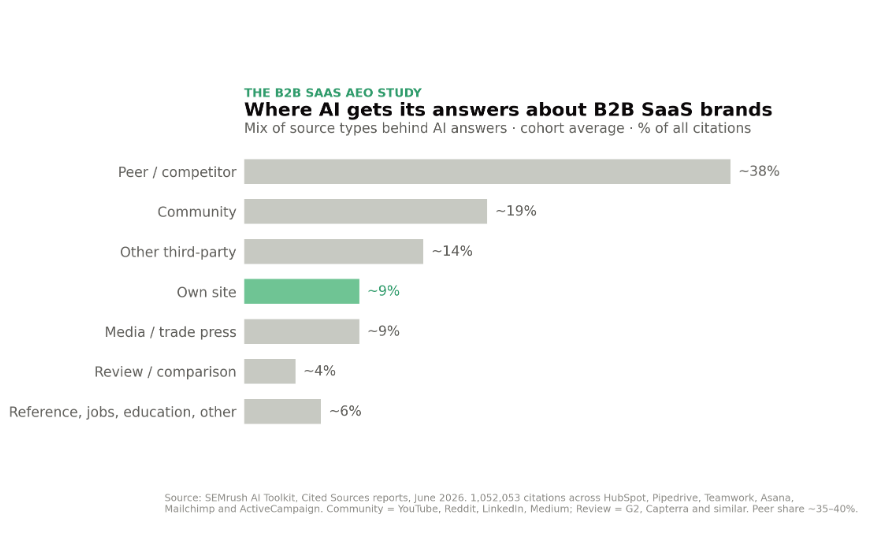
Read that table as ingredients rather than instructions. It describes what these answers were composed of; it doesn't prove any one source type causes a mention. But it shows which sources are reliably in the mix when established B2B brands get talked about.
The competitor share surprises people. It shouldn't: buyers ask comparative questions, so answers are built comparatively. "Best tools for X" pulls in round-ups and comparison pages that belong to other companies. Competitors appearing alongside you isn't a failure of the system. It is the format.
Brand Mention or Brand Source Citation? Define Both Before You Measure Either
These two terms get used interchangeably, and the confusion costs money. They describe different events and move independently.
- Brand mention: your brand is named in the answer, as a percentage of answers. This is the visible outcome your buyer reads.
- Brand source citation: your own website is cited as a source behind the answer, as a percentage of answers. This is the material the model reached for.
A brand can be mentioned without its site being cited at all, and cited without being mentioned. Both terms are used in that sense for the rest of this guide.
How Do You Create Answer-Ready Content?
Write expert content in a structure a model can extract. Most B2B SEO content underperforms not because it's weak, but because it's built as an argument that unfolds, while answer engines scan for self-contained blocks. The fix isn't writing worse. It's front-loading the substance you already have.
Lead With the Answer
Every page targeting an informational query should open with a direct answer of one to three sentences before elaborating. It's the highest-impact structural change most content teams can make, and costs nothing but discipline.
Use Questions as Headings
Headings phrased as questions map to the way buyers prompt, and make it obvious which part of your page answers which question.
Keep Paragraphs Short
Two to four sentences. If a point needs more, give it a subheading. Long flowing prose reduces extractability, however good the writing.
Define Your Terms in Standalone Blocks
Any concept central to your category deserves a self-contained definition early in the page. Definition queries are among the most common prompt formats in B2B, and content that answers them cleanly tends to be reached for.
Add an FAQ, and Make Authorship Explicit
FAQ sections give models extractable question-and-answer pairs that map precisely to conversational queries: five to eight per pillar page. Alongside them, name your authors, keep heading hierarchies clean and add appropriate structured data. None of it is glamorous, but all of it makes a model's job easier. Our Hybrid AI Content approach covers this in more detail.
How Do You Build the Authority Behind the Answer?
Authority for AEO is corroboration, not just backlinks. When independent sources describe your brand in consistent terms, a model can build a confident picture of what you are. This section is the longest here for a reason: it's where the citation data points most directly, and it's the part most B2B brands have barely started.
How Much of an AI Answer Is Your Own Site?
Less than most marketers assume. Across the six brands studied, brand source citation ranged from 9% to 32% of the answers that mentioned them. Even for large platforms, the brand's own website was the source behind roughly a quarter of the answers naming it.
That figure needs reading carefully, because the wrong conclusion is expensive. It does not mean your website stops mattering. Owned content does the eligibility work: without a strong, extractable page there's nothing for a model to cite and no reason to treat you as a credible source. Third-party presence does the breadth work: it's what the rest of the answer is made from. You need both, and they're different jobs.
The practical implication is a split in effort. Once your foundations are in place, most ongoing AEO effort belongs off-site, because that's where most of the answer lives.
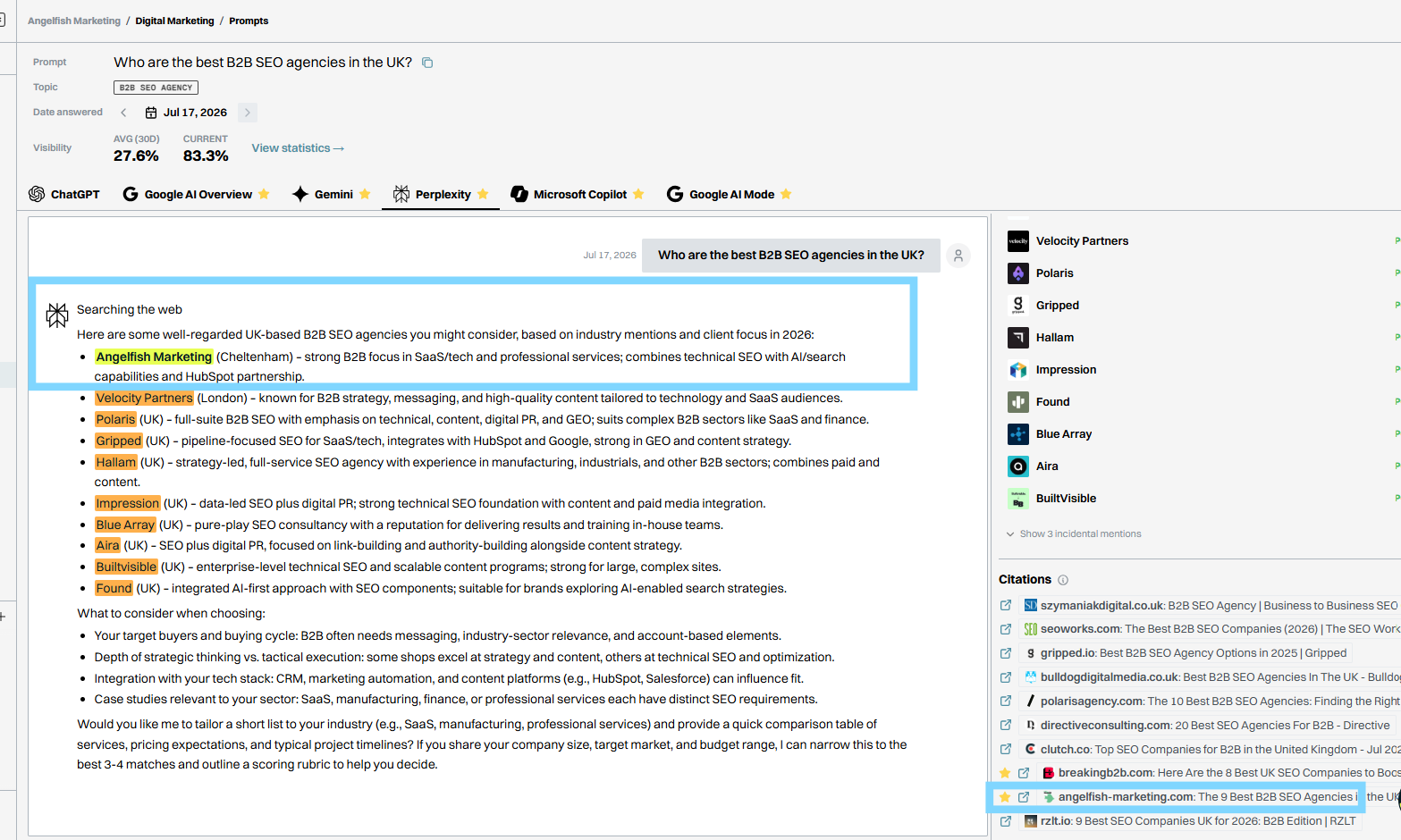
You can see in the example below inclusion the answer response is based on citation surfaces which include brand being mentioned in relevant directories, third party sites endorsing the brands and own site content supporting the topic answer.
Which Off-Site Work Targets Which Sources?
This is where the citation data becomes a plan. Each tactic below targets a specific part of the citation pool, which tells you why it exists and roughly what share of the answer it addresses.
| Tactic | Source type it targets |
|---|---|
| Listicle and comparison placements | Competitor and peer sites, the largest share at ~38% |
| Strategic guest articles | Trade and media press, plus peer sites |
| Digital PR placements | Trade and media press (~9%) |
| Press releases and wire distribution | Trade press, plus entity corroboration at scale |
| Directory and review platform listings | Review platforms (~4%), primarily entity corroboration |
| Community participation | Community platforms (~19%) |
| Publishing original research | Makes you the source others cite |
Listicle and Comparison Placements
The biggest opportunity, and the least understood. When a buyer asks an AI which vendors to consider, the sources it pulls are overwhelmingly other companies' comparison pages. Getting onto credible "best X" lists is direct work on the largest slice of the citation pool, and the slice most brands ignore because it doesn't look like marketing.
Strategic Guest Articles
Not link building wearing a different hat. The value is a substantive piece under a named author, on a publication models already retrieve from. Judge the target by whether it gets cited, not by domain rating.
Digital PR Placements
Earning coverage in the trade press your buyers and the models both read. Around 9% of citations in our study came from trade and media press, and those placements do double duty: reaching humans mid-evaluation and feeding the retrieval layer. This is where link building and digital PR earn their place in an AEO programme.
Press Releases, Directories and the Entity Layer
Group these together, because they do the same job, and it isn't the job most people think they're buying.
Wire distribution is worth being clear-eyed about. It can produce a few genuine pickups worth a great deal, and many syndicated duplicates worth very little as citations. Those duplicates aren't worthless, though, because every one carries your boilerplate.
That's the entity layer. Not every piece of off-site work is a citation play; some is corroboration, meaning consistent brand facts repeated across enough independent sources that a model can build a confident picture of you. Directory listings sit at around 4% of citations, which looks marginal until you understand citations aren't primarily what they're for.
What directories, review profiles and release boilerplate all do is replicate the same facts — founding date, partnerships, specialism, location, who you serve — across dozens of domains. Consistency is what a model corroborates against. Inconsistency works against you: conflicting facts make a model less confident about citing you at all.
So agree a single canonical description of your business and use it everywhere without variation: website, directories, review platforms, LinkedIn, partner listings, release boilerplate. The "About" block at the foot of a release isn't filler. It's an entity record published to dozens of domains at once, and one of the most valuable paragraphs a B2B company writes.
Measure this work differently, too. Entity corroboration won't show up as a rise in citation rate, and judging it on that metric makes it look like it failed. It shows up in whether models describe your business accurately, which you can test by asking them.
Community Platforms: Reddit, Medium and LinkedIn
The second-largest source type at around 19%, and the one most B2B brands handle worst. It deserves proper attention, not a line in a deck.
Reddit is heavily retrieved and the least gameable of the three. Most B2B marketers still file it under consumer channels, which is a mistake, though the figures need care because published numbers vary depending on what's measured. Ahrefs Brand Radar data covering June 2025 put Wikipedia as the most-mentioned domain across ChatGPT, Perplexity and AI Overviews, cited in 16.3% of ChatGPT responses. A separate Semrush analysis of 150,000 citations from the same period, measuring how often a domain appears at all rather than mention share, put Reddit ahead at around 40%. Both are primary studies; they measure different things and can't be stacked.
Two caveats worth writing into your plan.
First, platform behaviour differs enormously. Perplexity leans on Reddit considerably harder than ChatGPT; Gemini barely touches it. There is no single "AI SEO" covering all of them, which is why prompt tracking runs per platform.
Second, the figures are volatile. Semrush's three-month tracking study recorded Reddit's ChatGPT citation share collapsing from roughly 60% in early August to around 10% by mid-September 2025, then recovering.
Medium and LinkedIn work differently. They're publishing surfaces, so a named expert's writing can be retrieved on its own merits without a community accepting you first. LinkedIn has climbed sharply in citation rankings over the past year, making it the easiest of the three to start with.
What works across all three is the same: real participation by named people who know the subject, answering questions properly where your buyers already ask them, publishing under a real name with a real professional history behind it. There's no shortcut, and attempts to find one are usually visible.
Publishing and Referencing Original Research
Two distinct activities. Publishing original data makes you the source rather than the summary: the thing others cite in their own round-ups. Referencing credible research, yours and other people's, gives every other tactic something worth pitching, which is the difference between a guest article that lands and one that gets ignored.
What Does a Practical B2B AEO Strategy Look Like?
A practical AEO strategy is five steps, in order: scope the prompts that matter, diagnose what's cited for them, fix the foundation, win placements on those sources, then measure monthly. The sequence matters more than the sophistication. Most brands that struggle with AEO have skipped to tactics without knowing which prompts they care about or what's currently cited for them.
- Scope the prompts that matter. List the 10 to 20 questions a buyer asks while building a shortlist in your category: comparison prompts, criteria prompts, category definitions. Not keywords, but questions phrased the way someone would type them.
- Diagnose what's cited for them. Run those prompts across the platforms your buyers use and record two things: who gets named, and which sources each answer draws on. That source list is your target list, and it's specific to your category.
- Fix the foundation. Entity consistency across every profile you control, one citation-grade pillar page on your core topic, and one distinctive positioning claim. Without these, off-site work has nothing to point at.
- Win placements on the cited sources. Work the target list from step two using the tactic that matches each source type: comparison pages for peer sites, digital PR for trade press, participation for communities, profiles for review platforms.
- Measure breadth of presence monthly. Track mentions and source citations across platforms, watching how presence spreads across the source list rather than fixating on one number.
Where Does Generative Engine Optimisation Fit?
Generative engine optimisation is simply another label for the answer-engine work this guide describes. Most practitioners use GEO and AEO interchangeably, and the distinction matters far less than whether the work is happening.
How Do You Measure AEO Performance?
Measure AEO across six signals, none of which works alone. Prompt visibility tells you whether you appear; citation frequency tells you whether you're being read. With competitor comparisons and referral data alongside, they give a picture no single metric can.
- Prompt visibility. How often you're named across your tracked prompt set, by platform, and the core measure in any B2B SaaS search programme.
- Citation frequency. How often your own site is a cited source behind those answers.
- Brand mentions. Named appearances tracked over time rather than as a snapshot.
- Competitor comparisons. Who else appears for your prompts, and which sources carry them.
- AI referrals. Google Search Console surfaces AI Overview impressions, and analytics platforms increasingly separate AI referral traffic.
- Leads and assisted conversions. Referral traffic mapped back to pipeline in your CRM, which HubSpot handles natively if attribution is set up properly.
One warning: different tools measure different things and produce numbers that don't reconcile. Pick your instrumentation and stay with it. Comparing this quarter's figure from one tool with last quarter's from another tells you nothing.
Where to Start
If you do one thing after reading this, make it step two above: run your 10 most commercially important prompts and write down what gets cited. Most teams find that more clarifying than any audit, because it replaces assumptions with a list of sources to work on.
If you'd rather have it mapped properly, our AEO team can audit where your brand appears across answer engines and what's cited to describe you. Book a free strategy session and we'll walk through the gaps.