


The B2B SaaS AEO Study: Inside 1,052,053 AI Citations
The B2B SaaS AEO Study: Inside 1,052,053 AI Citations
Most research on AI search is built on consumer brands, where one high-intent search ends in a checkout. That tells you nothing about B2B SaaS, where a purchase takes months, a buying committee, and a stack of comparison documents. So we ran our own study, looking only at B2B SaaS, and the picture is very different.
We analysed 1,052,053 AI citations across six established B2B SaaS platforms to answer one question: when AI talks about a B2B SaaS brand, what sources does it build the answer from? We break down every type of source behind those answers (competitors, communities, review sites, the press and the brand's own site), and what it means for getting your brand cited.
Mention vs Citation: Two Words That Decide Everything
A brand mention and a citation are different events. A mention is the brand being named in the AI's answer: the visible outcome your buyer reads. A citation is a source the AI drew on to build that answer — the reference underneath. A brand can be mentioned without its own site being cited at all, and the gap between the two is where this study starts. (One clarification here: "mention" means the brand being named in an AI answer, not an off-site brand mention.)
This distinction matters because many conversations about AI visibility confuse the two. Semrush, whose AI Toolkit provided our data, separates them exactly this way: its Cited Sources report tracks the domains referenced in an answer, while its Prompts report tracks, separately, every brand named in the AI response itself. The prize and the mechanism are measured as two different things, because they are.
We use two terms throughout. Brand mention is when the brand is named in the answer; across our cohort, that happens in 92–99% of relevant answers. Brand source citation is when the brand's own website is cited as one of the sources behind that answer, which happens in 13–32% of those answers (around a quarter). AI names these brands almost every time, but reaches for their own site as a source about a quarter of the time. Which raises the question every B2B marketer should be asking: if AI isn't reading your own site to talk about you, what is it reading? The rest of this study helps answer that.
Where Does AI Get Its Answers About B2B SaaS Brands?
When AI talks about an established B2B SaaS brand, it assembles the answer mostly from sources other than the brand's own website: competitors, communities, review platforms and the trade press. The brand's own site is one contributor among many. The visibility is real; it is just built, for the most part, out of territory the brand does not own.
Here is the full composition, averaged across the cohort. Because the answers in this study are overwhelmingly ones that mention these brands, this breakdown is effectively the anatomy of a mention answer. 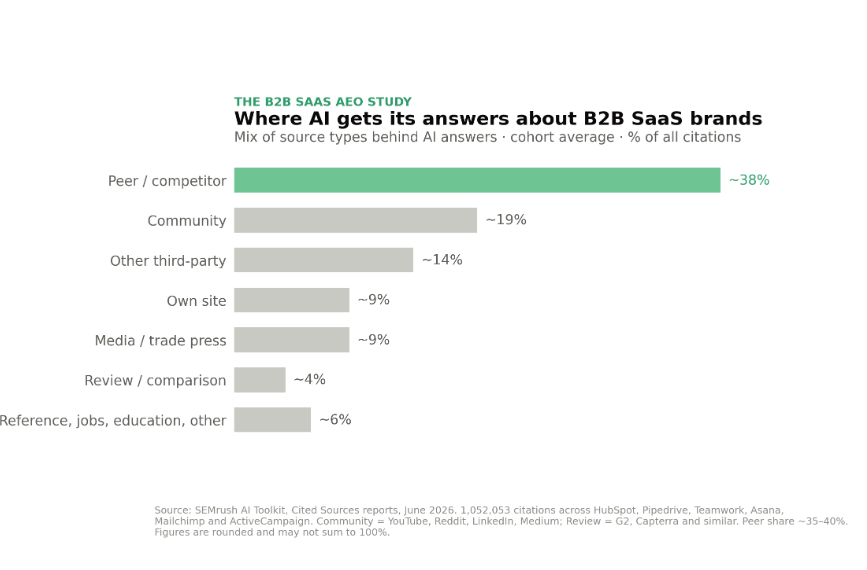
Note: the ~9% Own site is a share of all the citations behind all answers. The 13–32% figure below shows how often the brand's own site appears in the answers that mention its brand.
For a marketer, that table is the closest thing to a set of ingredients. It does not prove any one source causes a mention, but it shows which source types are reliably in the mix when these brands get mentioned.
Why "Competitors" Is the Biggest Source, and Why That Isn't Bad News
Because AI answers B2B software questions by comparison. Ask "what's the best CRM for a small sales team?" and you don't get one tool in a vacuum; you get several lined up side by side, because that's how buyers evaluate. So every brand appears in the company of its competitors by default. That ~38% isn't AI promoting your rivals over you; it's AI weighing the field, which is exactly what the buyer asked for.
The prompts in our data bear this out. The most common are comparative and shortlist-style: "top CRM software", "best tools for growing a SaaS company", "open source alternatives to X".
This reframes competitive content from threat to lever. Think about where you and your competitors appear together: the "X vs Y" pages, the category round-ups, the listicles, the review-site profiles. These aren't places to fear them showing up. They're where being present and well-represented is the whole game, because the comparison is happening with or without you. The brand that's absent from the comparison isn't protected from it; it's just losing it quietly.
Why Are These Brands Mentioned So Often But Rarely Their Own Source?
These brands are named in 92–99% of the AI answers in their space; their own website is cited as a source in 13–32% of those answers, around a quarter of the time. AI talks about them confidently using, in the main, other people's material. That distance, between being named everywhere and being sourced rarely, is what makes the rest of this study matter: if your own site isn't what AI is reading, the question becomes what is.
Read it the encouraging way, too. Own-site content is not absent; it is cited alongside a mention in up to a third of answers (32% at the top end, closer to a quarter typically). So owned content does earn its way into the answers that mention these brands a meaningful share of the time. It participates. It is a real ingredient, just not the main one.
For a growing brand, the lesson isn't "publish less". Most have the opposite problem, with thin or barely-there content that needs building before AI has anything to treat them as a credible source. Owned content is the foundation. It's what makes you eligible to be cited at all. The point is that it's the start of the job, not the whole of it. The part where the real distance lies, is presence across the off-site sources AI actually pulls from: the community platforms, review sites, trade press and comparison content that make up most of every answer. Build the content so you're eligible, then build the off-site presence so you're in the answer.
Which of Your Own Pages Actually Earn AI Citations?
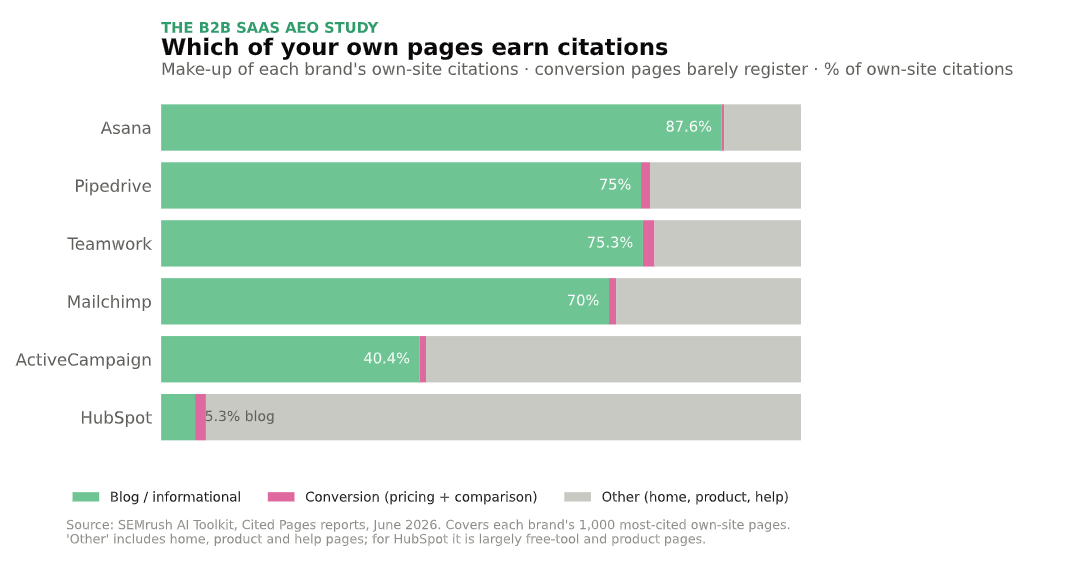
For most brands, informational content does the work. Blog and resource pages account for the large majority of own-site citations: around three-quarters for Pipedrive and Teamwork, close to 90% for Asana. Conversion-focused pages (pricing and direct comparison) barely register at roughly 1% across every brand. But that low number needs reading carefully.
It does not mean your pricing pages do not matter. That low figure mainly reflects the prompt set itself: the dataset is dominated by informational queries, with few buying-stage prompts of the kind a pricing or comparison page is built to answer. So this study can't say much about the final buying-stage answer either way; it is largely outside what this prompt set captured, and worth treating as an open question rather than a settled one. Two honest caveats on what we can see: HubSpot is the clear exception, earning citations from free tools and product pages rather than its blog; and this analysis covers each brand's most-cited pages, not every page ever cited.
Which Sources Should B2B SaaS Brands Target for AI Visibility?
We found 42 sources cited across all six brands that you can realistically build a presence on. When you strip out competitors, you're left with community platforms, review and comparison sites, and trade press. What recurs is structural to how AI answers B2B SaaS questions. Swap in six different B2B SaaS brands and you would expect the same kinds of sources to dominate. This is the part of the study you can act on.
YouTube and Reddit lead everything: together, they are the two most-cited sources in the entire study by a wide margin. Behind them, three more surfaces stand out:
- LinkedIn is the third most-cited source in the whole study, ahead of every review site and publication. Treat it as a primary AI citation surface, not just a posting channel: company-page content, executive and employee posting, and articles all feed answers about B2B SaaS brands.
- Trade press. Fifteen titles recur across the cohort (TechRadar, Forbes, PCMag, TechTarget and others). The way into that bucket is digital PR: original data, commentary and spokespeople, the same earned-media work that builds authority, which is why earned media is an AEO channel, not just a brand-awareness one.
- Medium is a high-volume, under-used citation surface: open, well-indexed and reached for by AI, which makes it an efficient home for long-form, point-of-view content.
Underneath those, review and comparison platforms (G2, Capterra, GetApp, Gartner, TrustRadius) are the most directly workable surface of all, because profile completeness and review volume are something a marketing team can manage directly.
Here are the top 20 of the 42 actionable sources by citation volume.
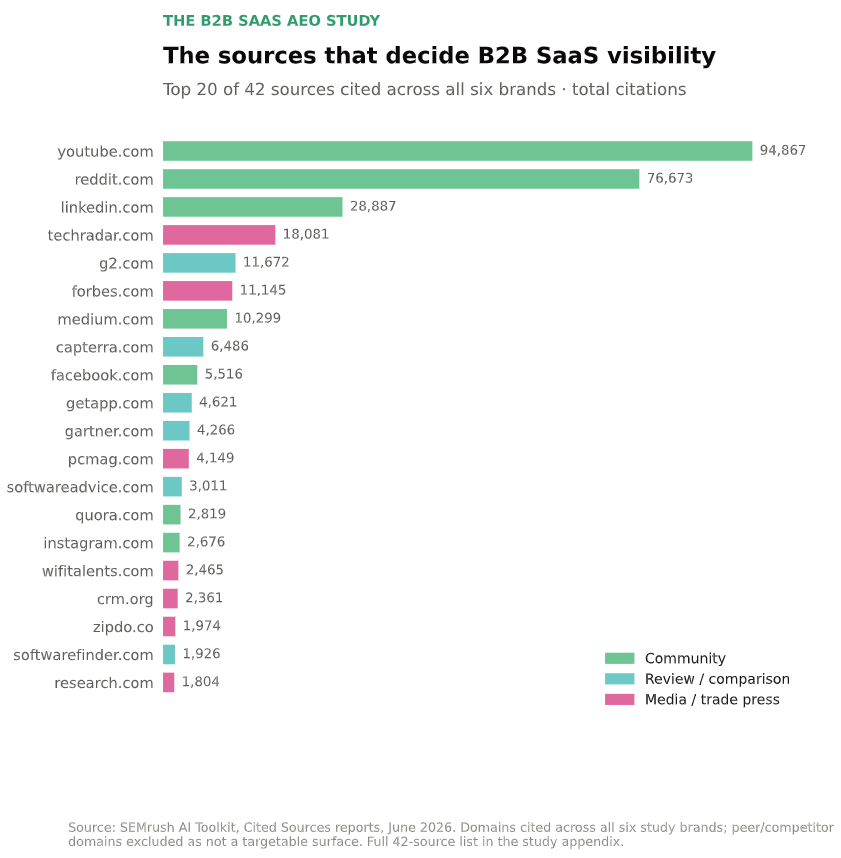
The real value is not any single name; it is that the list is finite and known. AEO can feel boundless, but you do not optimise for the whole internet. You work a ranked list of the source types that demonstrably feed answers in your category, starting at the top. That is a brief a marketing team can finish.
What Should B2B SaaS Marketers Do About AI Search?
Earning a place in AI answers is two jobs, not one. Owned content earns eligibility: it is how a brand qualifies to be a credible, citable source. Presence across third-party sources earns the answer; that is what AI actually reaches for. Most growing brands have only built the first, and the second is where the largest gap between effort and reward sits.
The six brands here were named in 92–99% of relevant answers, but that is the finished picture, not the starting point for many small and mid market SaaS brands. Plenty of B2B SaaS brands are not being mentioned by AI in any meaningful way yet, and that is the normal position for a brand in growth mode. The study turns that finished picture into a blueprint you can build toward, brick by brick. We call the spread of places a brand shows up across this landscape its citation surface area: the wider and more credible it is, the more raw material AI has to build you into an answer.
Roughly in the order a growing brand should build:
- Get your foundations citable first. Create genuinely useful informational content and the technical SEO foundations underneath it. This is what makes a brand eligible to be cited at all. Strong B2B SEO is the base everything else builds on.
- Track your source-citation rate, not just whether you are mentioned. How often your own site is cited as a source behind a mention is a concrete, trackable target. Established brands sit around a quarter; moving up from near-zero is the goal for a younger brand.
- Weight your effort roughly 80/20, off-site to on-site. The citations live overwhelmingly off your own site, so a rough campaign split puts most AEO effort in third-party presence and earned media, with a smaller share on the owned content that keeps you eligible. Treat 80/20 as a sense-check on where ongoing time and budget go once your foundations are in place, not a precise formula and not the order you build in.
- Do not mistake publishing for presence. Producing more of your own content builds the foundation that makes you eligible to be cited. But on its own it does little to grow your presence across the third-party sources that make up most of the answer. That's a separate job.
- Build presence on the contested sources, starting with five. YouTube and Reddit first, then LinkedIn, Medium and digital PR. Review-site presence sits alongside as the most directly manageable surface.
- Treat comparison as a channel, not a threat. For a challenger brand, getting into the round-ups and "X vs Y" content is half the battle.
None of this replaces traditional SEO. It builds on it. Based on the two years we have spent implementing AI SEO across our client base, eligibility is where the work starts, not where it finishes. The brands that win AI visibility are original sources, not content that echoes others, and that is as true for your owned content as it is for the earned coverage that carries most of the answer.
Find Out What AI Is Saying About Your Brand
This study is built on a similar audit we run for clients: where your brand shows up across the sources AI reaches for, and where the gaps are. If you want to know what AI is saying about your brand, and what it is citing to say it, book a free strategy session with our team.
Frequently Asked Questions
What is the difference between an AI mention and an AI citation?
A mention is the brand being named in the AI's answer: the visible outcome a buyer reads. A citation is a source the AI referenced to build that answer. A brand can be mentioned without its own site being cited, and a site can be cited without the brand being mentioned. They are linked but distinct.
What sources does AI use to build an answer about a B2B SaaS brand?
Across our study of 1,052,053 citations, the answer is built mostly from third-party sources: competitor and peer sites (~38%), community platforms like YouTube, Reddit and LinkedIn (~19%), the trade press (~9%) and review platforms (~4%). The brand's own website is one contributor among many, at around 9%. The remainder is other third-party, reference and uncategorised sources.
Which sources does AI cite most often for B2B SaaS?
YouTube and Reddit are the two most-cited sources, followed by LinkedIn and Medium. Review platforms (G2, Capterra, Gartner) and trade press (TechRadar, Forbes, PCMag) also recur across every brand we studied.
Does AEO replace traditional SEO?
No. Answer engine optimisation builds on traditional SEO; it does not replace it. Strong technical and content foundations are what make a brand eligible to be cited by AI in the first place. AEO is included by default in Angelfish SEO packages, not bolted on as a separate service.
How can I tell if my brand is being cited by AI?
Track citations and brand mentions using AI visibility tools, monitor AI referral traffic in your analytics, and run your key commercial queries across ChatGPT, Perplexity and Google AI Overviews each month to see which brands appear. The sharpest metric is your source-citation rate — how often your own site is cited as a source behind a mention.
How We Ran This Study
We analysed 1,052,053 AI citations across six established B2B SaaS platforms (HubSpot, Pipedrive, Teamwork, Asana, Mailchimp and ActiveCampaign) spanning CRM, project management and marketing automation, two brands per category. Data came from the Semrush AI Toolkit (Cited Sources, Prompts and Cited Pages reports), exported June 2026 and blended across ChatGPT, Google AI surfaces (AI Overviews and AI Mode) and Gemini.
A few points of method, in the interest of transparency. Each data set is capped at the 1,000 most-cited sources per brand, so every figure describes the most-cited sources (the citation mass) rather than the full long tail. Three candidate brands (monday.com, Zendesk and Freshdesk) were excluded because their names pulled non-software noise into the data. And this is a descriptive snapshot: we describe what the citation landscape is composed of, and where we suggest a mechanism such as the buying journey, we flag it as interpretation, not a causal finding.
One boundary worth naming: every brand here is an established category leader, so the study shows what a mature citation footprint looks like, not whether the same mix holds for a smaller challenger.
Appendix: The Full List of 42 Cited Sources
These are all 42 sources cited across every brand in the study: the community platforms, review and comparison sites, and trade press AI reaches for regardless of which brand or category it is discussing. Peer/competitor domains are excluded, as are jobs, reference and education sites, which are not surfaces you can practically build a presence on. Ranked by total citations across the cohort.
Community (9)
| Source | Citations |
|---|---|
| youtube.com | 94,867 |
| reddit.com | 76,673 |
| linkedin.com | 28,887 |
| medium.com | 10,299 |
| facebook.com | 5,516 |
| quora.com | 2,819 |
| instagram.com | 2,676 |
| github.com | 944 |
| tiktok.com | 937 |
Review / comparison (18)
| Source | Citations |
|---|---|
| g2.com | 11,672 |
| capterra.com | 6,486 |
| getapp.com | 4,621 |
| gartner.com | 4,266 |
| softwareadvice.com | 3,011 |
| softwarefinder.com | 1,926 |
| sourceforge.net | 1,567 |
| toolradar.com | 1,440 |
| trustradius.com | 1,385 |
| spotsaas.com | 1,190 |
| technologyadvice.com | 1,000 |
| slashdot.org | 999 |
| propicked.com | 895 |
| softwaresuggest.com | 754 |
| capterra.com.au | 746 |
| crozdesk.com | 695 |
| itqlick.com | 651 |
| selecthub.com | 382 |
Media / trade press (15)
| Source | Citations |
|---|---|
| techradar.com | 18,081 |
| forbes.com | 11,145 |
| pcmag.com | 4,149 |
| wifitalents.com | 2,465 |
| crm.org | 2,361 |
| zipdo.co | 1,974 |
| research.com | 1,804 |
| ventureharbour.com | 1,794 |
| techtarget.com | 1,677 |
| investopedia.com | 1,614 |
| business.com | 1,516 |
| techrepublic.com | 1,280 |
| businessnewsdaily.com | 1,179 |
| gitnux.org | 930 |
| worldmetrics.org | 643 |
Note on research aggregators: several media entries (wifitalents.com, zipdo.co, research.com, gitnux.org, worldmetrics.org) are statistics-aggregator sites AI reaches for when it wants a figure to cite. We include them because the data shows AI citing them, not as a recommendation to pursue placement on them.