

B2B SaaS SEO Strategy 2026: The Complete Guide for Marketing DirectorsSEO
Organic search still drives 44.6% of B2B revenue. At the same time, the channels through which that visibility is earned have fundamentally changed. AI Overviews, Google AI Mode, Perplexity, and ChatGPT have introduced a parallel discovery layer that sits above traditional search results — one that your buyers are already using, and that most SaaS marketing teams are not yet optimising for.
This guide covers what B2B SaaS SEO strategy looks like in 2026: the foundations that still matter, the new AI layer that cannot be ignored, and a practical implementation framework built for marketing directors who need to connect organic search to pipeline revenue.

What is B2B SaaS SEO strategy?
B2B SaaS SEO strategy defined:
A B2B SaaS SEO strategy is a systematic programme for building organic and AI-driven search visibility around the topics your buyers research before purchasing. It combines technical site health, topical content architecture, authority-building through backlinks and E-E-A-T signals, and answer engine optimisation — all measured against pipeline and revenue outcomes, not traffic alone.
SaaS SEO differs from general B2B SEO in three important ways. First, buyer journeys are longer and more research-intensive: SaaS buyers average five to seven content touchpoints before engaging sales. Second, the category keywords are typically high-competition: established players have years of accumulated domain authority. Third, the commercial outcomes — recurring revenue, expansion, churn prevention — require SEO to support not just acquisition but the full customer lifecycle.
Why B2B SaaS SEO strategy needs rethinking in 2026
Three structural shifts have changed the competitive landscape since 2023.
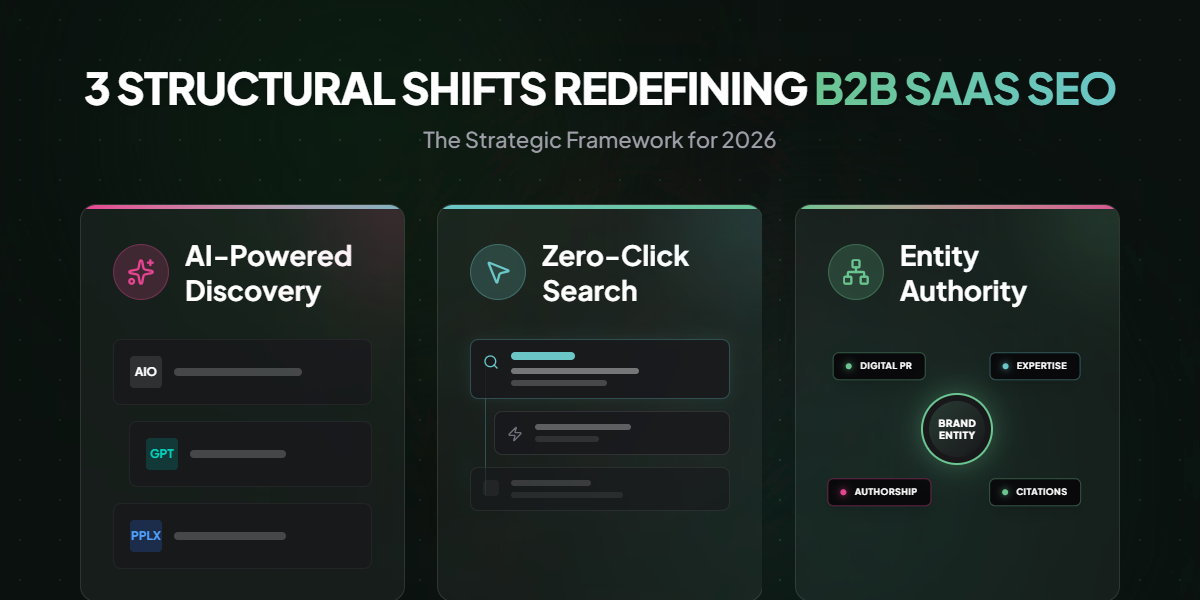
1. AI-powered discovery is now mainstream
ChatGPT has over 800 million weekly active users. Google AI Overviews reach 2 billion users monthly. Google AI Mode — the dedicated conversational search interface — is expanding rapidly across markets. Buyers now routinely ask AI systems the same questions they previously typed into search bars, and the AI answers them directly, often without a click.
The brands cited in those AI responses are not always the brands that rank number one organically. They are the brands that have built the deepest topical authority and the most consistent external presence — which is why AEO is now a core component of SaaS SEO strategy, not an optional add-on.
2. Zero-click search has become the norm
Organic click-through rates in the UK and EU have fallen from 47.1% to 43.5% in the past two years as users increasingly get answers directly in the SERP. Featured snippets, AI Overviews, and knowledge panels now resolve a significant proportion of informational queries without a click. The opportunity is not gone — brands cited in AI Overviews earn 35% more clicks than brands that simply rank without citation — but the strategy required to capture it is different.
3. Entity authority has replaced keyword matching
Google's systems increasingly evaluate brands as entities with attributes, relationships, and credibility signals — not as keyword-matching documents. A SaaS company that ranks for 50 loosely related queries will be outperformed by a competitor with deep, interconnected content around a narrower topic. Building entity authority — the clear, consistent, corroborated signal of who you are and what you know — is the foundation of modern SaaS SEO.
The seven pillars of B2B SaaS SEO in 2026
Effective SaaS SEO rests on seven interconnected elements. These are not sequential steps — they operate in parallel and reinforce each other over time.
1. Technical SEO foundation
Core Web Vitals, mobile-first indexing, clean crawl architecture, XML sitemaps, and structured data are the table stakes. A slow, poorly-structured site limits the return on every other investment. Prioritise: page speed (LCP under 2.5 seconds), crawl efficiency (no orphaned pages or duplicate content), and schema markup for authors, organisations, and FAQs.
2. E-E-A-T and entity authority
Google's quality raters assess content against Experience, Expertise, Authoritativeness, and Trustworthiness. For SaaS brands this means: named authors with verifiable credentials and linked profiles, case studies with quantified outcomes, an About page that establishes company history and customer base, and third-party citations from credible sources.
Entity authority signals matter beyond individual pages. Your brand's consistent presence across review platforms (G2, Capterra), industry publications, partner listings, and social profiles collectively tell Google and AI systems who you are and why you can be trusted.
3. Topical authority through content clusters
Build interconnected content organised around your core revenue themes: a pillar page targeting the broad topic, eight to twelve cluster pages targeting specific subtopics and buyer questions, and a clear internal linking architecture connecting them all. This signals topical depth to search engines and creates a conversion journey for buyers navigating from awareness to decision.
Revenue-first topic selection: choose pillar themes that map to your highest-margin product lines or clearest competitive differentiation. A cluster that ranks should create sales conversations, not just traffic.
4. Answer engine optimisation (AEO)
AEO structures your content so that AI systems — Google AI Mode, AI Overviews, ChatGPT, Perplexity — extract and cite your brand as a direct answer to buyer queries. The structural requirements are specific:
- Lead every informational page with a direct one to two sentence answer before elaborating
- Use question-format headings that map to the queries buyers actually type into AI systems
- Include definition blocks for key terms — AI systems are frequently asked "What is X?" and preferentially cite content that answers clearly
- Add FAQ sections to pillar pages — these are among the most-cited content formats in AI-generated responses
- Implement FAQ schema and Article schema with populated author and organisation fields
5. Backlink strategy and digital PR
Backlinks remain the strongest external authority signal in both traditional and AI-driven search. 99% of URLs that appear in Google AI Overviews also rank in the top 20 organic results — and both require the domain authority that quality backlinks build.
For B2B SaaS, the most sustainable link acquisition model combines: original research (data studies that industry publications cite), digital PR (pitching expert commentary and findings to relevant media), expert contribution (bylines and podcast appearances that earn author-level citations), and category directories and integration partner listings.
Quality over quantity is not a cliché here — it is a measurable reality. One link from an authoritative industry publication is worth more than fifty links from low-relevance directories.
6. HubSpot integration and pipeline attribution
The most common SEO measurement failure in SaaS marketing is stopping at traffic and rankings. Pipeline attribution — connecting organic search activity to deals in your CRM — is what transforms SEO from a cost centre to a predictable revenue channel.
Configure HubSpot to capture first landing page and UTM values for every organic contact. Use SEMrush to track prompt citations and brand mentions in AI-generated outputs. Map AI Overview referral traffic in HubSpot back to pipeline and revenue performance. The result: a clear commercial view of which clusters, topics, and pages influence deal closure — your strongest board-level argument for continued SEO investment.
7. Measurement and continuous optimisation
Report on clusters, not individual pages. Report on revenue influence, not just traffic. Review which cluster pages are attracting the right buyers and which are attracting the wrong ones. Expand content in the clusters that are driving pipeline; deprioritise or consolidate content in clusters that are generating traffic without commercial outcome.
What to measure: B2B SaaS SEO metrics that matter
Track performance at three levels: visibility, engagement, and revenue impact.
| Level | Metric | Why it matters |
|---|---|---|
| Visibility | Keyword rankings (top 3 / top 10) | Leading indicator of organic traffic potential |
| AI Overview impressions (Google Search Console) | Measures AI-driven discovery layer presence | |
| Brand citation frequency (SEMrush AI tracking) | Tracks how often AI systems cite your brand | |
| Engagement | Pages per session within cluster | Signals whether buyers are following the content journey |
| Organic conversion rate (sessions to leads) | Benchmark: 2–5% for B2B SaaS | |
| Revenue | Organic contacts and MQLs (HubSpot) | Connects traffic to qualified demand |
| Pipeline influenced by organic (HubSpot attribution) | Multi-touch view of organic's role in deal closure | |
| Cost per acquired customer (SEO spend ÷ deals closed) | The ROI metric that justifies investment to the board |
Implementation: a practical 90-day start point
A full SaaS SEO strategy compounds over twelve to eighteen months. The first ninety days should establish the foundations:
- Technical audit: crawl your site, identify Core Web Vitals issues, fix duplicate content and crawl inefficiencies, implement schema markup for authors and organisation
- Cluster planning: select three revenue-aligned pillar topics, map eight to twelve cluster pages per pillar, define buyer intent stage and CTA for each page
- E-E-A-T baseline: create or refresh author profiles with verified credentials, publish at least one case study with quantified outcomes, audit brand consistency across G2, Capterra, LinkedIn, and partner pages
- Pillar page production: draft and publish the first pillar page with AEO-optimised structure: direct answer in the opening, question-format headings, definition blocks, FAQ section with schema
- Link acquisition launch: identify three to five target publications for digital PR outreach, plan first original research asset, audit existing partner and directory listings
- HubSpot tracking: configure contact source tracking, create cluster-level GA4 exploration, establish baseline for organic leads and pipeline influence
Months four through twelve: execute content production across all three clusters in parallel, run quarterly digital PR campaigns, optimise based on conversion data, and expand into a fourth and fifth cluster as resources allow.
Ready to build a B2B SaaS SEO strategy that drives pipeline in 2026?
Angelfish Marketing builds data-led SEO and AEO strategies for B2B SaaS and tech brands — from topic cluster planning to HubSpot pipeline attribution. Book a free strategy session and get a competitor analysis, content audit, and 90-day action plan.